
What once was a desirable safe haven in suburbs, cities, and off-highway towns is now… a ghost town. Shopping malls across the US have shuttered the stores that once kept Americans busy for hours on the weekends and offered hundreds of jobs for the community. Indoor and outdoor destinations that once served as the mecca for commerce have been struggling to adapt in the omnichannel retail environment where consumers prefer to trade their dollars online.
Research by Capital One shopping indicates that the total number of malls has decreased 16.7% from 2017 to 2022, and that 2 million square feet of abandoned mall real estate was demolished in 2022 alone.
Vacating monumental epicenters within communities further drives the isolation that is impacting modern American society. Rather than abandoning malls and wiping them from the land, pivoting their strategic purpose could be just the solution needed to help restimulate brick-and-mortar retail and bring communities back together in real life.
Shopping malls can consider these 5 opportunities to bring life back to their businesses:
1. Centralize Second Hand Shopping
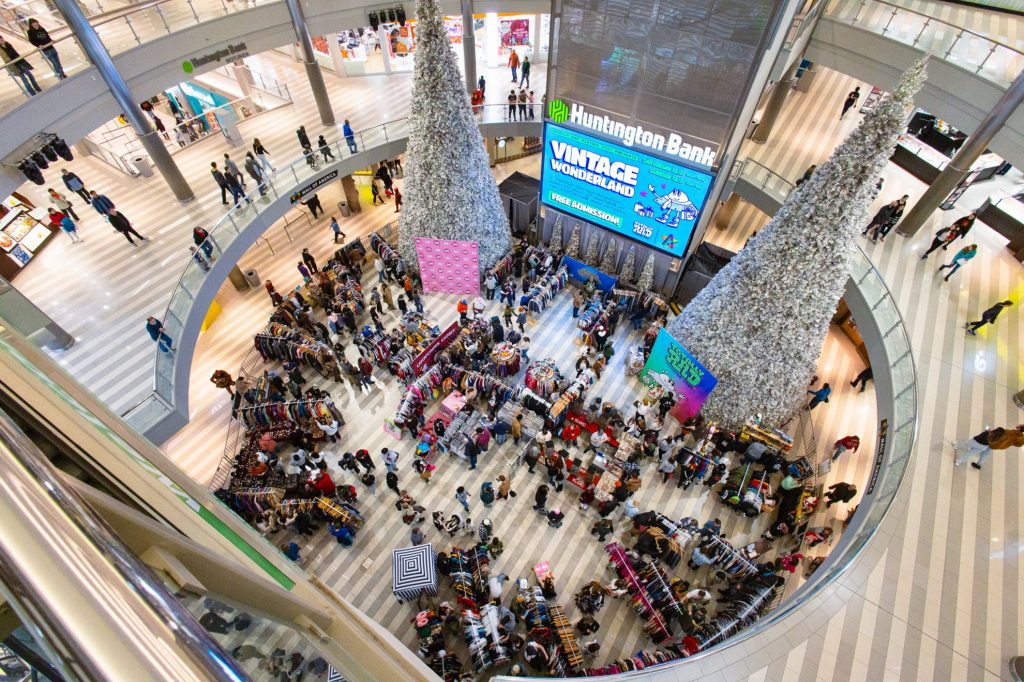
We can’t revive the malls without acknowledging the recent increase in buying second hand. For many reasons, consumers are interested in continuing the product life cycle of already existing garments, accessories, household items, furniture, and decor. Curated second-hand shops could line the mall just like retailers and boutiques. The mall provides a physical place for the fashion, style, and trend lovers to decorate a small physical space and curate an assortment for a test market prior to expanding their business into a larger, and potentially more expensive, space or market. Pop-up events are also a common destination for vintage resellers to come together and expand their reach.
Totally Rad Vintage Fest is an up-and-coming vintage festival that travels around the midwest, making shopping curated vintage assortments more accessible to consumers and helping vintage curators expand their business. Mall of America housed the Totally Rad Vintage fest in December 2023, bringing secondhand shopping to the same venue as retail. Expanding shopping malls capabilities to include support for relevant pop-up events like this vintage fest is a modern take on how shopping malls can be used.
2. Utilize Malls to Make Live Music More Accessible
Live music today is increasingly more difficult for fans to experience. With record-high ticket prices, hidden fees charged by third-party platforms, and ticket resellers reducing availability to the public, the distance between artists and their fans is growing. Music in the 2010s used to be available for listeners and fans to more readily access in their broader communities. Boy band Big Time Rush had performed at Mall of America in Bloomington, MN, and Fifth Harmony built their fan presence by performing in local malls across the country. Revisiting an element from the past’s playbook, with a twist, could meet consumers’ needs in a meaningful way.
Vacant malls have the available real estate to rework abandoned retail spaces into reasonable-sized music venues for local & regional tours, up-and-coming talent, and pop-up performances. Everywhere can’t house a Soldier Field or Coachella size performance, but a more intimate approach to live music venues could be just the response needed. The aesthetic environments that speakeasies and jazz bars have built into their identity could be leveraged to add personality, and give people across the country somewhere else to go and connect.
3. Establish Malls as Press Tour Venues
The streaming era has produced many great TV shows and movies to the forefront, tugging on the heart strings of its viewers. Streaming services, like Netflix, have relied on TikTok and YouTube to share press tours out to the general public. In-person press tours and meet-and-greets are an opportunity to bring the consumer along in a more stimulating environment. Merchandise can be sold at the events, and actors and actresses have the ability to feel the impact of their work more directly. Vidcon is an example of a larger scale meet-and-greet based event that has served as a key interaction point for YouTubers and social media personalities with their fans. The crowd a loved TV series, like Bridgerton, could bring out to a shopping mall destination could be just the boost needed for shops and restaurants at that location.
4. Eliminate Barriers for Returning Items Purchased Online
Buying clothes online becomes a pain for consumers when they have to return something. Retailers have attempted to ease this pain point by covering return shipping costs, and allowing online orders to be returned to drop-off locations, but the true opportunity lies in enabling returns at a venue where consumers are already shopping. For example, Kohl’s accepts Amazon returns at their store locations, and SHEIN allows shoppers to return their items to Forever 21 stores.
Other retailers like ASOS and Boohoo, and brands with limited locations across the country, like Uniqlo, could benefit from these return hub locations in the mall, so the consumer can shop and return all in one trip.
5. Establish Shopping Malls as a Community Hub
American society is desperately craving available third places that appeal to the tendencies and behaviors of the modern day consumer. The most desired preference is ease. In an environment that is already challenging enough to consumer’s minds, bodies, and pockets, a difficult routine is not desired. A third place that can appeal to many needs, instead of just one, could be the solution to the busy American schedule. Some malls currently provide this all-in-one approach to their strategy, but establishing the mall as a utopia with tranquil ambiance and life appeals to the consumer’s senses. Many malls today can feel a bit sterile or utilitarian, failing to initiate a sense of relaxation or distraction from the challenges of the day.
Shaping shopping malls into a transformative ambiance that consumers want to go to increases the leisure foot-traffic, as well as creates a third place for casual gathering, like date nights or girl’s days.
At its core, people want to feel inspired and connected to others. Bridging the gap between individual, digital platform, and reality is key to keeping shopping malls alive. Rather than continuing to mold mall’s infrastructure to serve one purpose, they must become more dynamic to meet the needs of the community.
Victor Gruen, inventor of the modern mall, knew that there needed to be more to shopping malls than consumerism only. The experience of shopping malls needed to excite shoppers, encouraging them to spend more time in the space and spend more money. Today, American malls are lacking that inspiration and excitement needed to draw consumers there and drive them to spend more money.
Although shopping malls are facing challenges at the macro level, there are some malls within the United States that have withheld the storm. Take Mall of America in Bloomington, Minnesota as an example of success. The largest indoor mall in the US has an indoor theme park, 520 stores, and an aquarium. According to Mall of America By the Numbers, the mall sees around 40 million visitors a year, bringing in $2 billion in sales for the state of Minnesota.
Shopping malls don’t have to be the largest in the land in order to capture the attention of the consumer, but they do need to stay up to date with the latest behaviors and sentiments that are driving consumers to leave the house and spend their money. Restructuring these mega infrastructures doesn’t have to be complex either. Consumers today are already showing us what they are invested in and what nostalgic elements they wish to experience once again.
 THE IDENTITY CRISIS